

Striped Vinyl Flooring
Striped Vinyl Flooring
If stripes are what keep catching your eye, the useful question is what you want them to do to the room.
A wide stripe can feel calm and architectural. Narrower lines bring more rhythm. Run them one way and they can pull the eye through the space; turn them and the whole floor reads differently.
Then there’s colour. Two shades can keep things simple, several can make the floor much more playful, and softer tonal stripes can bring pattern without the contrast taking over.
Start with the room you already have — the cabinetry, wall colour, furniture and the direction you naturally look when you walk in.
Ready to browse? Explore all patterned vinyl flooring →
Start with the rhythm of the stripe
Stripes can change dramatically with width, spacing, colour and direction. Start with the bit you already notice first — broad bands, finer lines, a simple two-colour repeat or something with a little more movement.
An even repeat feels steady. A mix of wider and narrower bands changes the rhythm again.
Wide and simple
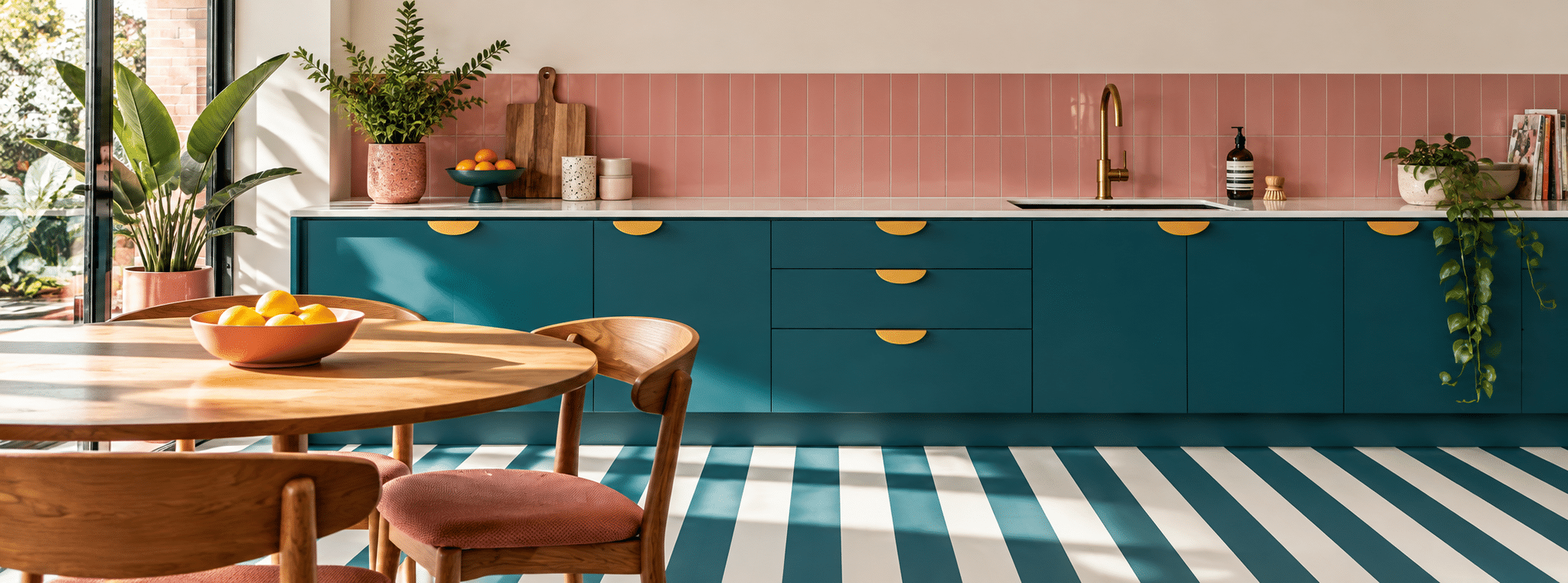
Broad bands leave more space between the lines, so the floor can feel calm and architectural. Useful beside a long run of cabinets, or when you want a few clear bands rather than a tight repeat underfoot.
Narrower stripes
Finer lines repeat more often, so the rhythm is easier to see. That can feel ordered and lively. It can also feel busier where a lot of floor stays visible, simply because you see more of the repeat.
Two-colour
Two shades are the simple classic. Strong contrast, such as navy and white, makes the structure very clear. Closer shades keep the same structure and quieten it down. If black and white is the contrast you keep coming back to, that is its own decision too.
Tonal stripes
Similar shades — sage beside stone, cream beside taupe, a run of blues — give you the stripe without a hard contrast. The lines are still there. They just don’t take over the room.
Multicolour
Several colours make the floor more playful. You don’t have to echo every one of them. One colour that already lives in the cabinets, the walls or the furniture is often enough to connect the floor back to the room.
Diagonal, or a change of direction
The same stripe can read differently once you turn it. Lengthways, it can draw the eye through the room. Across, it can sit with a run of cabinets. On a diagonal, the lines travel another way again. What you get depends on the room and the layout.
Make the stripe fit the room, not the other way round
You may already know the colour you want. Or which way you want the stripe to run. With the right striped design, those choices can lead the floor rather than the room having to work around a fixed version.
This applies to Stripe Navy and Stripe Black. It does not apply to every striped design on the site.
See what stripes do in a real room
A pattern square shows you the colours. A whole room shows you the direction — where the eye travels, how often the stripe repeats and what happens when those lines meet cabinets, walls and furniture.


Start with the room you’re changing
If it’s the kitchen
Look at the stripe beside the cabinet run and the worktop, and at which way you naturally walk through the room. A wider band can sit calmly along that line. A finer repeat will show up more often in the floor that stays visible.
Lengthways, the lines can draw the eye through the space. Turn them to run across, and they sit differently against the cabinets. The effect depends on the room and the layout.
If it’s the bathroom
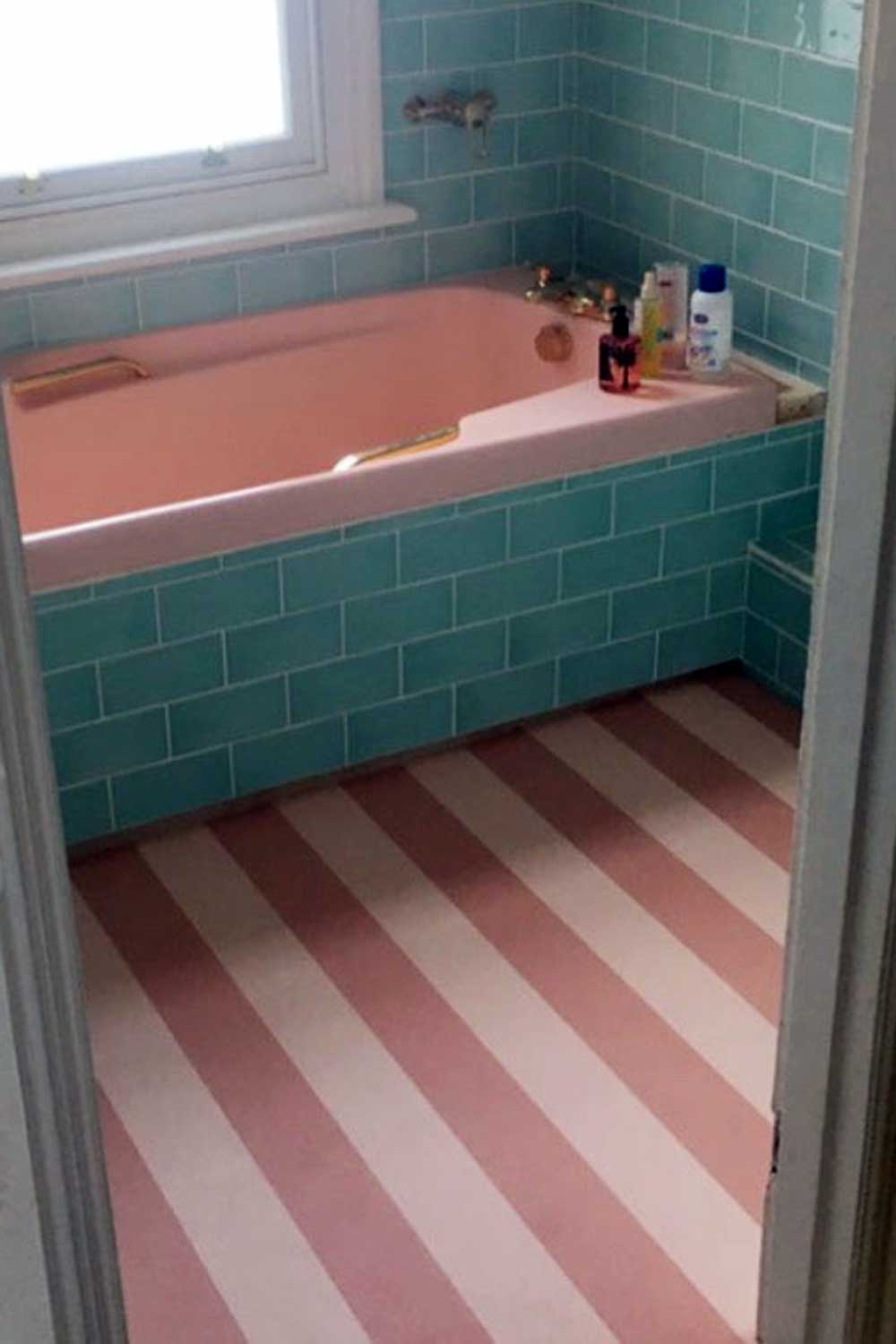
A bathroom often leaves a useful amount of floor between the bath, basin and door, so width and direction are easier to judge. Tiles and fittings may already be doing plenty.
The stripe can quietly structure what’s left of the floor, or it can be the thing you notice first. Worth looking at how the lines will meet the fittings before you decide.
And if it’s a smaller room?
Don’t automatically make the stripes narrower because the room is small. More lines can sometimes make the floor feel busier simply because you see more repeats.
Look at how much floor will actually remain visible, and which direction your eye naturally travels through the room. A wider stripe or a simpler two-colour repeat may give the floor more breathing space.
The useful things to know
Once you’ve narrowed the look down, these are the useful bits.
See the stripes you’re considering at home
Colour changes beside the things already in the room, and a stripe can feel very different once you see the width and spacing at room scale.
Samples help with colour and material. The pattern shown on a small sample may be reduced in scale; you’ll see the intended room scale and layout in your proof before production.
A few practical questions
Is striped vinyl flooring suitable for kitchens and bathrooms?
Yes. Our sheet vinyl can be used in kitchens, bathrooms, cloakrooms and utility rooms when correctly fitted over a suitable clean, flat and dry subfloor. It has an R10 slip-resistance rating.
Can the width or direction of striped vinyl flooring be changed?
On Stripe Navy and Stripe Black, the colours and the stripe width can be adjusted, and the direction can be changed where that layout is supported. This does not apply to every striped floor. The proof shows the intended scale and layout before the floor is produced.
Can striped vinyl flooring work with underfloor heating?
Yes. It can be used with suitable underfloor heating systems up to 27°C when the installation guidance is followed.
Found the kind of stripe you’re leaning towards?
You don’t need to work the whole room out from the screen. Start with the stripes that keep catching your eye, see the colours at home and think about which direction feels right for the room you have in mind.