

Circular Pattern Flooring Ideas
Circular Pattern Flooring Ideas
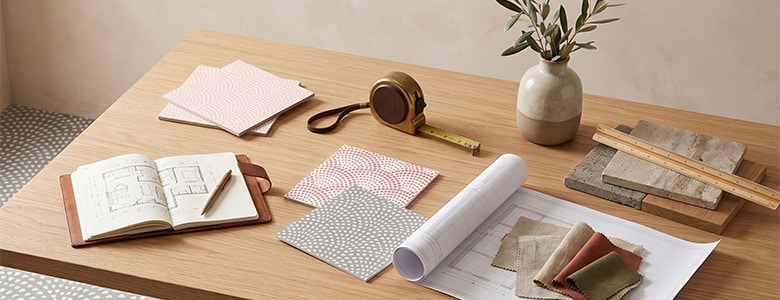
If it’s the curves that keep catching your eye, the useful question is what you want them to do in the room.
A large circle can feel bold and graphic. Smaller repeats create more rhythm. Overlapping shapes bring movement, while half-circles and arcs can give you the softness of a curve without the floor feeling full of dots.
Then look at what those curves will sit beside. Straight cabinet runs, square tiles and simple furniture can make a circular pattern feel even more noticeable — sometimes that contrast is exactly the point.

Start with the shape of the curve
Not every circular floor reads the same way. The size of the curve, how much of it you see and how closely it repeats can take the same basic idea from quiet and ordered to much more graphic.
Full circles and rings
When the whole circle stays visible, the geometry is easy to read. Larger rings make a stronger statement; smaller ones build more repetition across the floor.
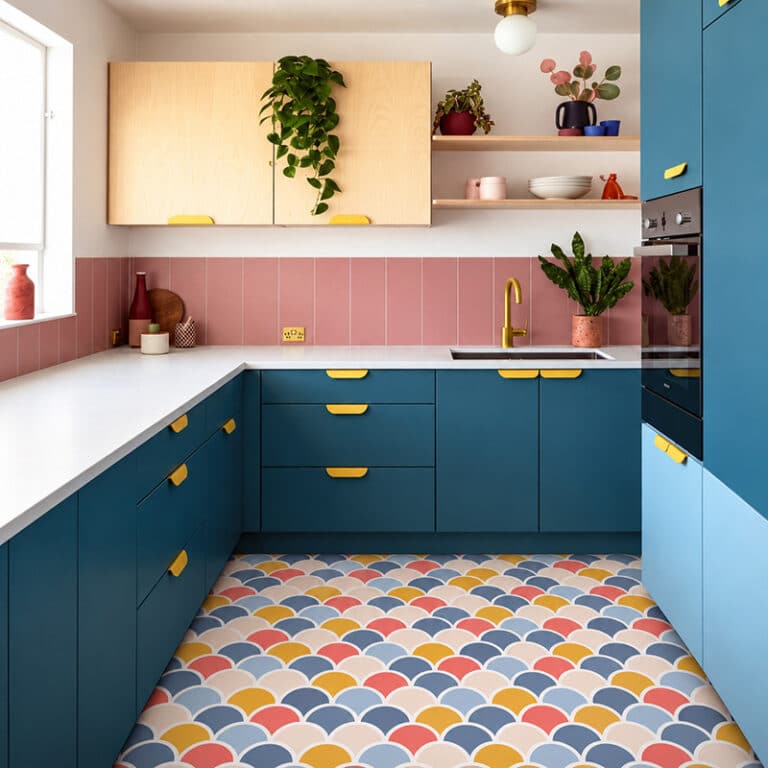
Half-circles and scallops
A curve does not need to close into a full circle. Half-circles and scalloped shapes can feel softer and a little less regular, especially when they overlap or change direction.
Overlapping circles
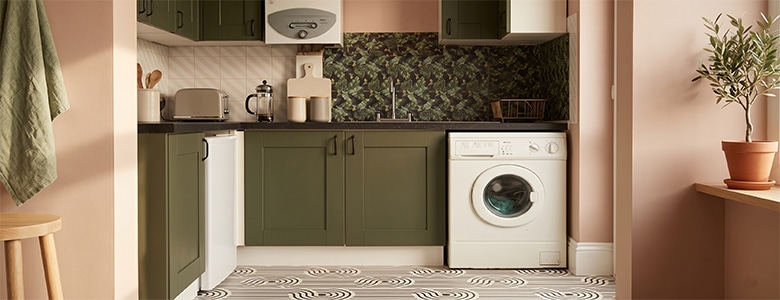
When one curve runs into another, the repeat starts to move. You notice the spaces between the circles as much as the circles themselves, which can make the floor feel more layered.
Small repeats
A smaller circle repeats more often, so you see more rhythm across the same amount of floor. That can feel lively in an open room and much busier where only a small patch stays visible.
Large and graphic
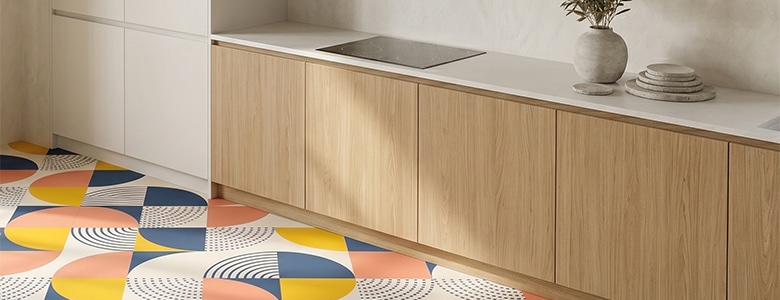
Bigger forms leave more breathing space between repeats. In a fairly simple room, one strong circular motif can do most of the visual work without needing much else around it.
Colour changes the geometry
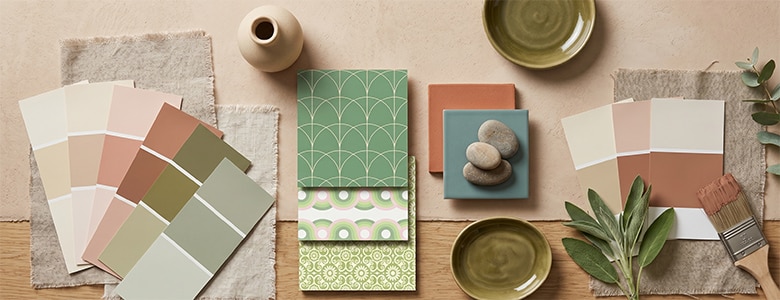
The same curve can feel very different in black and white, two close tones or a brighter palette. Strong contrast makes the shape clearer; closer colours let the curves sit more quietly.
See how the shape changes from one floor to another
A circle can be the whole motif, part of a larger repeat or simply the curve that holds the pattern together. Seeing a few side by side makes the difference in scale, spacing and repetition much easier to judge.


Look at what all those curves will sit beside
If it’s the kitchen
Kitchens give circular patterns plenty of straight lines to play against — cabinet runs, worktops, islands and tile grids.
If the units are simple, a larger curved repeat can become the thing you notice first. If there is already plenty happening in the cabinetry or splashback, a closer-toned circle or more open repeat may sit more comfortably.
Look from the doorway as well as straight down. That is where you get the clearest sense of how the curves read across the room.
If it’s the bathroom
Bathrooms often leave a useful patch of floor visible between the bath, basin and doorway, so the shape of the repeat can be surprisingly clear.
A bold ring or overlapping curve can work beautifully beside plain sanitaryware. With busier tiles, it is worth noticing whether you want the floor to echo that movement or give the room one calmer repeat.
In a smaller room, look at how often the circle repeats
Don’t automatically make the pattern smaller because the room is small. A tighter repeat can sometimes make the floor feel busier simply because you see more circles in the same space.
Look at the amount of floor that will actually remain visible once everything is in place. A larger curve may give the pattern more room to breathe; a smaller one may suit you better if it is the rhythm you like.
WHEN YOU GET TO THE PRACTICAL BITS
The useful things to know
Once you’ve narrowed the look down, these are the useful bits.
Comfortable underfoot, with an R10 slip-resistance rating.
Many rooms can be supplied in one piece; larger floors can be planned across matching panels.
Choose up to six designs and see the colour and material in your own room.
See the intended pattern scale before your floor is produced.
See the curves at room scale
Colour matters, but with circular patterns scale matters just as much. A small sample can tell you about the material and palette; it cannot always show you how often the circle will repeat across the whole floor.
The pattern shown on a small sample may be reduced in scale. Your proof shows the intended room scale before production, so you can see how the curves will actually sit across the space.
A few practical questions
Is circular pattern vinyl flooring suitable for kitchens and bathrooms?
Yes. Our sheet vinyl can be used in kitchens, bathrooms, cloakrooms and utility rooms when correctly fitted over a suitable clean, flat and dry subfloor. It has an R10 slip-resistance rating.
Is circular pattern flooring the same as circle-pattern floor tiles?
No. Circular and geometric tile patterns are often part of the same visual search, but the floors here are sheet vinyl. You get the repeating circle or curved look as a continuous floor rather than individual tiles and grout lines.
Can circular pattern vinyl flooring be used with underfloor heating?
Yes. It can be used with suitable underfloor heating systems up to 27°C when the installation guidance is followed.
Found the kind of curve you want to see at home?
You don’t need to work the whole room out from the screen. Start with the circular designs you keep coming back to, order a few samples and see what happens when the shape and colour reach your room.