
Patterned Flooring for Neutral Kitchens
Patterned Flooring for Neutral Kitchens
If the cabinets, walls or worktop are already fairly quiet, the floor has a little more freedom.
Maybe the kitchen is cream, mushroom, pale grey, soft white or timber. You might want the floor to stay in that same calm mood. Or you might be looking at all that restrained cabinetry and thinking it could take considerably more colour.
The useful question is not whether something “matches”. It is how much you want the floor to change the room — whether it should lead, or sit more quietly beside what is already there.
Start with what you can already see: cabinet colour, worktop, wall paint, timber, tile or one shade you would like to repeat. Patterned vinyl flooring can add depth and character without replacing the kitchen itself.
See patterned kitchen flooring ideas →
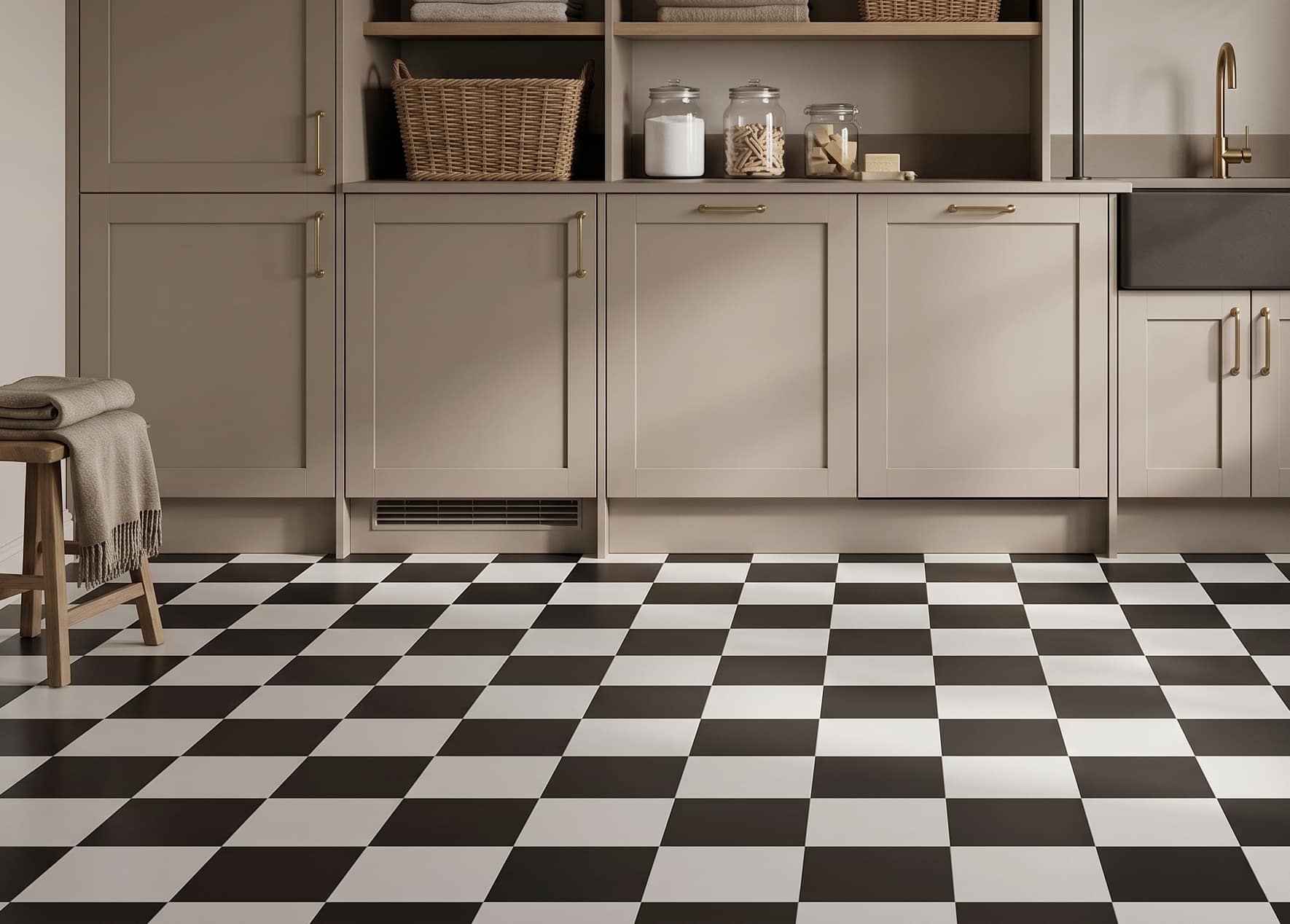
What do you want the floor to bring to the room?
Neutral cabinetry gives you options. The same kitchen can feel very different depending on contrast, colour and how strongly the pattern repeats across the floor you actually see.
Keep it tonal
Choose floor colours that sit close to the cabinets and walls. A checkerboard, stripe or soft geometric can add depth without a hard jump in contrast — useful when you want pattern, not drama.
Bring in one colour
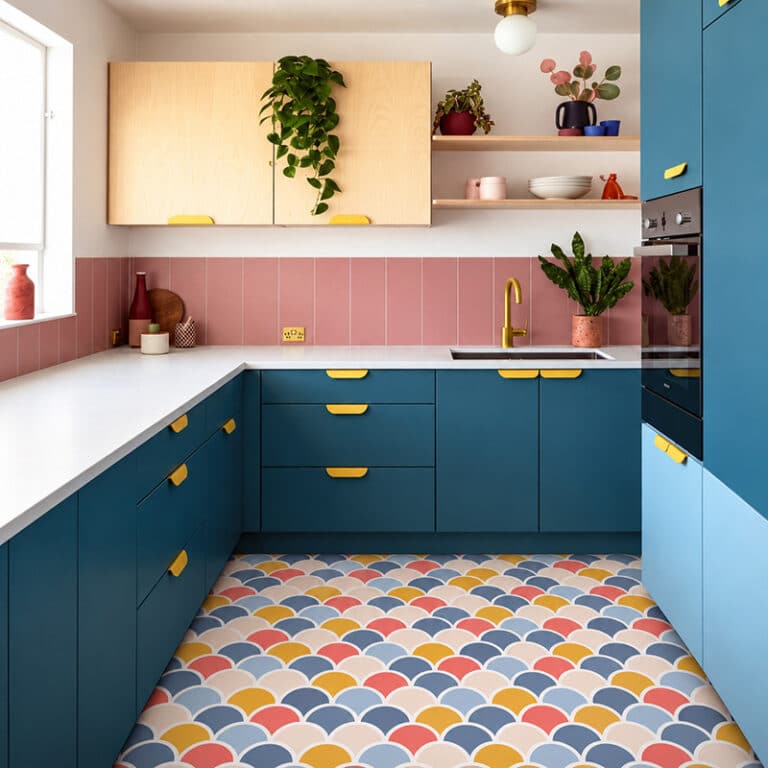
Take one colour you love — pink, green, blue, terracotta — and let the quiet cabinetry give it space. You do not need to repeat it everywhere; one clear relationship is often enough.
Go graphic
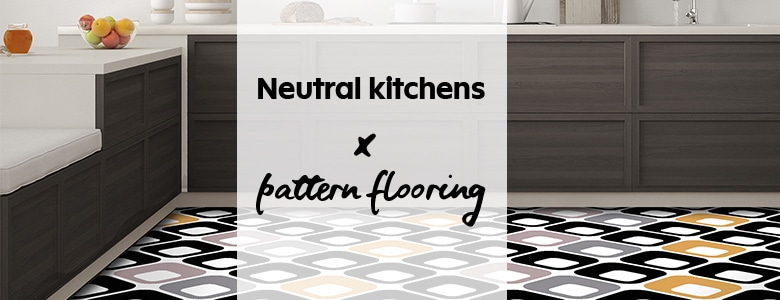
Black and white or stronger geometry makes the floor a clear feature. In a pared-back kitchen, that contrast can do a lot of the work while the cabinetry stays calm.
Warm up a pale kitchen
Cream, warm white and timber respond well to clay, ochre, terracotta, warm pink and earthy repeats. The floor can bring heat into the room without repainting every cabinet door.
Cooler colour beside grey
Grey and blue-grey cabinetry often suits blues, greens, cooler geometrics or crisp black-and-white. The undertone of the cabinets matters as much as the name on the paint chart.
Let the pattern do the work
When the joinery is deliberately simple, a stronger repeat — stars, stripes, terrazzo-style speckle, bold geometry — can carry more of the room’s character on its own.
Start with what the floor is sitting beside
Cabinet colour, worktop and wall paint all change how a pattern reads. Look at undertone and contrast before you worry about matching every shade in the room.
If the cabinets are warm
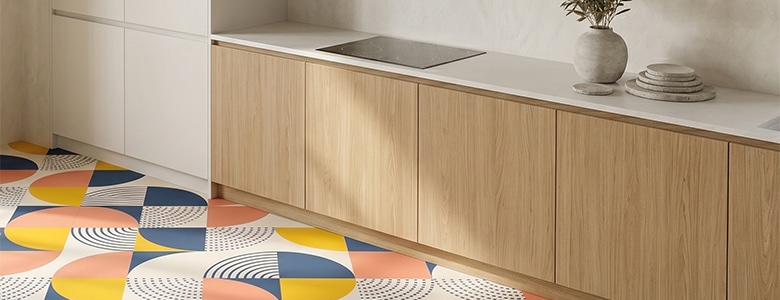
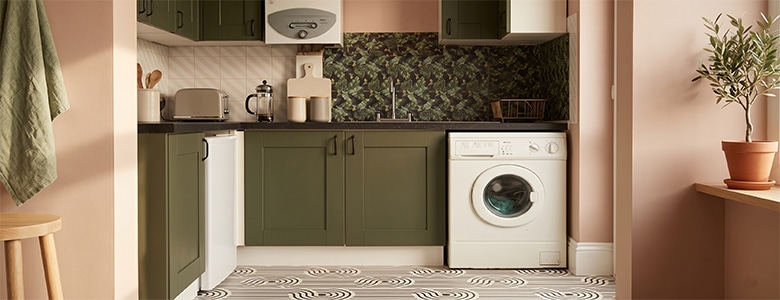
Cream, mushroom, taupe, oat and timber often sit well with clay, pink, ochre, olive, warm monochrome and softer tonal patterns. Terracotta-style geometry can feel grounded rather than loud beside chalky paint.
Where a design offers colour and scale changes — Chess and Elettra are two examples — you can steer the pattern towards the warmth already in the room.
If the cabinets are cooler
Grey, blue-grey and cooler white kitchens often suit blues, greens, black-and-white checks and cooler tonal combinations. A graphic floor can sharpen the room; a softer repeat keeps the palette calm.
Chess can be adapted in colour and square size when you want a checkerboard tuned to the scheme.
If something else already leads
A strong worktop, tile splashback or wall colour may already be doing most of the talking. The floor does not need to echo every tone — one thoughtful link between pattern and room is usually enough.
See what happens when the floor meets the kitchen
A sample square tells you the colours. Standing in the room tells you how much pattern you will actually live with — beside cabinets, worktops, light and the slice of floor left on show.
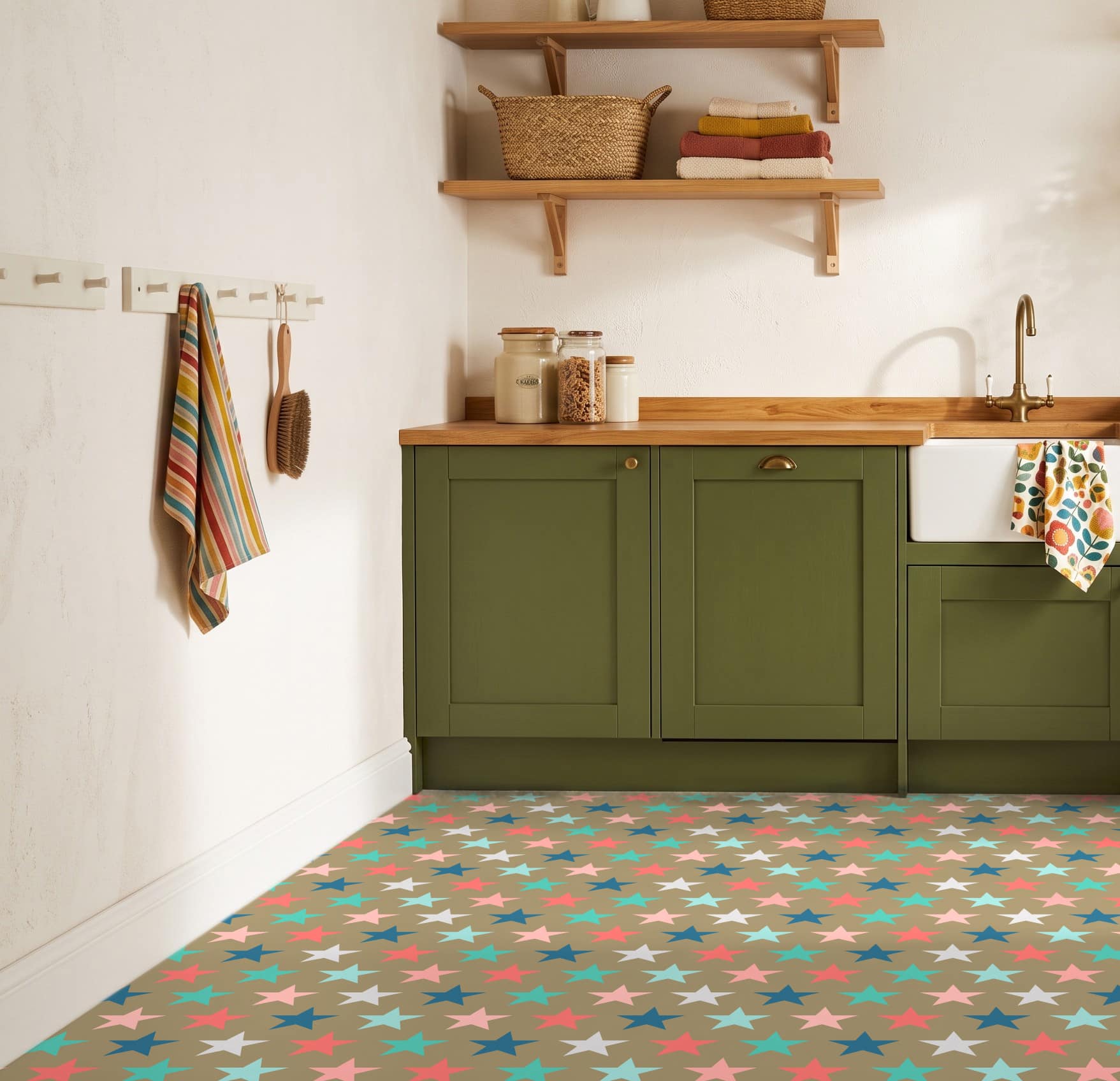

How much floor will you actually see?
Kitchens rarely show the whole pattern at once. A galley layout, a run of base units or a large island can leave only a strip of floor visible — and that changes how busy a repeat feels.
In a narrow kitchen, a tight pattern can read more quickly because you see it repeated along the whole sightline. Where more floor is on show — especially in an open plan — a larger repeat or stronger contrast often has room to settle.
Stand at the doorway and look from normal height, not only down at a sample on the worktop. That is usually the view you will live with.
The useful things to know
Once a shortlist has started to form, these are the practical details worth having to hand.
Sheet vinyl avoids grout lines, which many people prefer in a kitchen. It still needs a suitable clean, flat, dry subfloor and careful fitting — especially at edges and around units.
See the floor beside your kitchen colours
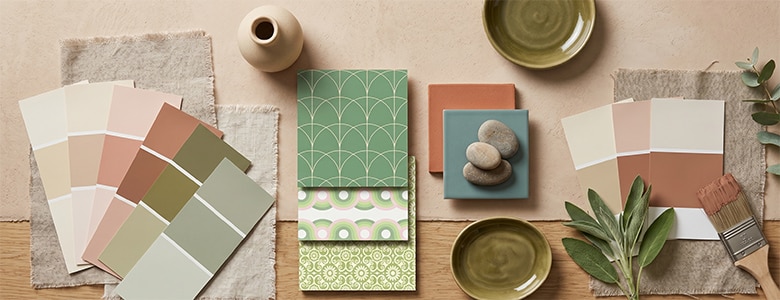
A neutral is never just “neutral”. Cream, grey, mushroom, stone white and timber all shift beside another colour — and they shift again in natural and artificial light.
Samples are especially useful here because the floor has to be judged beside a cabinet door, wall colour, worktop and hardware, not on its own. The pattern on a small sample may show a reduced scale; your proof shows the intended room scale before production.
If you are comparing black-and-white stars, Calixta is one of the designs where colour and scale can be adjusted as currently offered on that product page.
A few practical questions
Is patterned vinyl flooring suitable for kitchens?
Yes. Our sheet vinyl can be used in kitchens when correctly fitted over a suitable clean, flat and dry subfloor. It has an R10 slip-resistance rating.
What flooring colours work with a neutral kitchen?
It depends on the undertone of your cabinets and how much contrast you want. Warm creams and timber often suit earthy and pink-toned patterns; cooler greys often suit blue, green or black-and-white designs. Tonal patterns can bridge the two when you want colour without a sharp jump.
Will a bold patterned floor make a neutral kitchen feel too busy?
Not necessarily. Scale, contrast and how much floor remains visible all matter. A strong pattern in a kitchen with large islands and plenty of covered floor can feel quite different from the same design in a narrow galley.
Can patterned vinyl flooring be used with underfloor heating?
Yes. It can be used with suitable underfloor heating systems up to 27°C when the installation guidance is followed.
Still looking at that quiet kitchen?
You do not need to redesign the cabinetry to change how the room feels. Note the floors that keep pulling you back, order samples and see them beside the colours you already live with — then decide how much you want the floor to do.